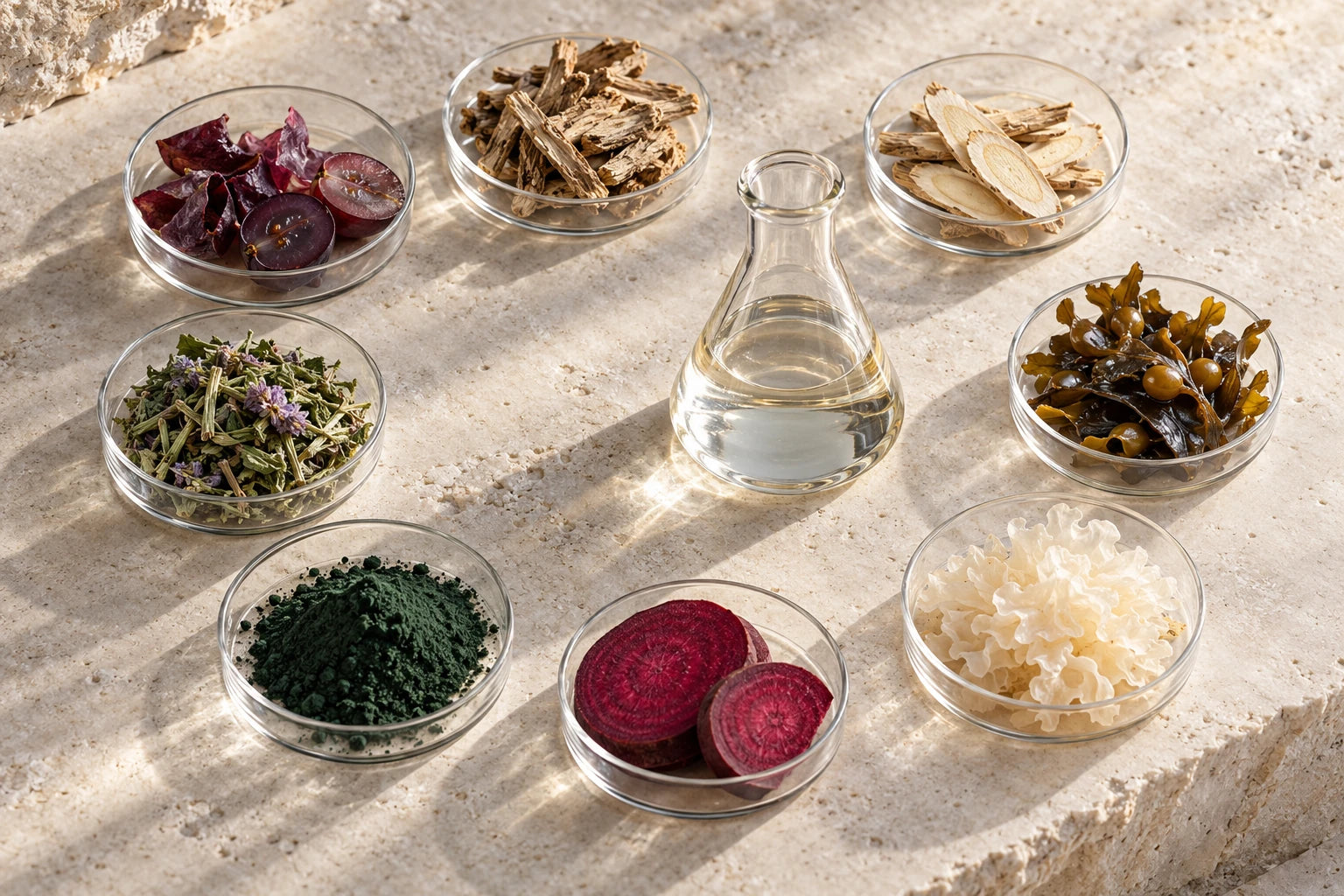
EIGHT SOURCES. A PROPRIETARY PROJECT.The intelligence
of nature.
Botanical, algal and fungal. The sources of the PhytoHeal phytocomplex tell the story of a project born where different worlds meet.
GET TO KNOW THE SOURCES
What they are.
What they can contribute.
Each source has its own wealth of compounds. Here you will find its characteristics and cosmetic interest; the label gives the complete composition of each serum.
Grapevine
Vitis viniferaPolyphenols and skin wellbeingThis is the grapevine: the leaves, distinct from the seeds and fruit, are used for this raw material.
- What it contains
- The leaves contain polyphenols, including flavonoids, phenolic acids and stilbenes. The extract's composition depends on variety, harvest and processing.
- Its cosmetic role
- In cosmetics, the leaf extract is a conditioning ingredient that helps keep skin in good condition. Its polyphenols are studied for antioxidant activity.
02BotanicalJapanese knotweed
Polygonum cuspidatumResveratrol and other polyphenolsJapanese knotweed is a plant whose root is a known source of phenolic compounds.
- What it contains
- These include resveratrol and other stilbenes; the extract is a plant mixture, distinct from pure resveratrol.
- Its cosmetic role
- Its cosmetic interest is linked to antioxidant potential. Studies of extracts show that no single molecule tells the whole story: the extraction method also affects the resulting profile.
03BotanicalAstragalus
Astragalus membranaceusFlavonoids and skin conditioningAstragalus is an Asian plant used to produce botanical extracts with a complex profile.
- What it contains
- The extracts studied contain flavonoids and their glycosides. The profile depends on the origin and the part of the plant used.
- Its cosmetic role
- Its cosmetic interest concerns skin conditioning: keeping skin in good condition. The flavonoids in the extracts are also studied for antioxidant potential.
04BotanicalAlfalfa
Medicago sativaA botanical blend of polyphenolsAlfalfa is a herbaceous plant used to obtain plant extracts with a complex profile.
- What it contains
- Its compounds of interest include polyphenols and flavonoids. The part used and the extraction process influence the raw material's composition.
- Its cosmetic role
- In cosmetics, its extracts are studied for antioxidant potential. The ingredient's value lies in its blend of plant compounds, characterised as a whole.
05AlgalBladderwrack
Fucus vesiculosusMarine polyphenols and softnessThis is a marine brown alga; the extract is obtained from the thallus, the body of the alga.
- What it contains
- Components studied include phlorotannins, polyphenols characteristic of brown algae, and carotenoids such as fucoxanthin.
- Its cosmetic role
- In cosmetics, it is used for skin conditioning and softness. Its phenolic fractions are also studied for antioxidant potential, which depends on the composition and type of extract.
06AlgalSpirulina
Spirulina platensisProteins and natural pigmentsSpirulina is a biomass of cyanobacteria, often called microalgae, belonging to the Arthrospira group.
- What it contains
- Proteins and pigments, including phycocyanin, characterise this raw material. Phycocyanin is a coloured protein responsible for the characteristic blue shade.
- Its cosmetic role
- This fraction is studied for cosmetic use as a pigment source and for antioxidant potential. Biomass characteristics and extraction quality are essential for obtaining a consistent raw material.
07BotanicalBeetroot
Beta vulgarisBetaine and affinity for waterThis is beetroot extract, a plant raw material distinct from isolated betaine.
- What it contains
- Betaine is an amino acid derivative naturally present in the plant. The extract's composition varies with botanical variety and processing.
- Its cosmetic role
- Betaine is used in cosmetics as a humectant: a substance that interacts with water. This is one reason beetroot is of interest in formulations focused on skin comfort.
08FungalTremella
Tremella fuciformisPolysaccharides and water retentionThis is a fungus with a gelatinous consistency, from which polysaccharides also used in cosmetic formulations are obtained.
- What it contains
- These long sugar chains consist mainly of mannose, with branches containing glucuronic acid and xylose.
- Its cosmetic role
- The structure has many groups capable of binding water. This affinity makes Tremella polysaccharides interesting for water retention and formula consistency, within a cosmetic approach focused on hydration and comfort.